Wireless and Broadband 24/7 in Indonesia

Blogger's Essentials
Bloggers' essentials... netbook: check - dongle: check - Lonely Planet: check
Whatever the new decade brings for technology and education, one thing seems fairly sure: the internet will only continue to become an almost undiscerning part of everyday life. As I sit typing this blog post on my netbook in the hills of West Java in Indonesia, I continue to be amazed by the simple fact that at any time during my three week stay here I can switch on, plug in and access the net cheaply and with a minimum of fuss.
With a little help from a 3G broadband USB modem which I managed to unlock from the 3 network last week for about six dollars (thanks http://www.online-unlock.com)  and an Indosat 3G broadband SIM (about thirty dollars), I have unlimited access to the net for the next thirty days!
A couple of months ago, I spent five weeks in East Timor. While 3G broadband access wasn’t an option there, the country has managed to set up a fairly good mobile phone network and you can find new mobiles as cheap as US$7 on the street. It’s easy to see that in only a short time, 3G technology will bring many in the developing world access to the internet and mobile phones could well be the key.
I now find myself arguing with many education experts that have quite outspoken opinions on what is and isn’t good for technology education in the developing world. Like the many opponents of the OLPC (One laptop per child) initiative, such experts argue that technology – though clearly important – should not be central to the concerns of school development in countries like East Timor.
While I don’t have a full case of evidence behind my position (although the EU council’s amendment 138-46 does lend some weight to this issue), I will continue to argue that internet access can and should be a basic human right for everyone in the world. The fact is that kids can with relative ease afford mobile phones and that such phones might be used in the near future to access resources like Wikimedia (with its free textbooks and encyclopaedias) or the Gutenberg online library of free e-books. The irony is of course that in many communities where mobiles are a fact of life, these kids can’t get access to traditional text books and teaching resources!
The bottom line is that it has never before been this easy for people such as myself to sit here and post this blog entry seemingly from the comfort of my netbook, USB modem and hotel deckchair. Perhaps this realisation might suggest that the potential for the internet as a vehicle for worldwide democracy, empowerment and social mobility might be just around the corner. At least we can dare to dream, right?
Blogging in style at my guesthouse in West Java

Being Catholic at Caroline Chisholm College

Like many tech-savvy teachers, I’ve been in the habit of filming my lessons from time to time and evaluating them. Although I don’t think I’ve hit the ‘saturation’ point, my kids often look at me and roll their eyes when they see the camera emerge and hear me slip into my best renditions of Michael Moore, John Pilger, Kerry O’Brien and all the other great interviewers I admire.

In spite of this, the following film  has to rate as one of the most challenging and rewarding to date. Last Wednesday my principal and I took a few hours to interview small groups of kids on what Catholicism means to them. The result was a powerful series of statements eloquently expressed by kids who in so many ways have profound awareness of what it means to be alive, compassionate; to learn, teach and give.

I did my best to pull the many strands together and interspersed interview footage with photos and video material recorded by other teachers and myself over the last few years. An emerging theme was the idea of vision and what it means to see both literally and figuratively (in a spiritual sense). The music I chose also communicated this message.

The whole process reminded me about the immense value of listening to children to learn more about oneself. I certainly learned a lot and will treasure this experience.

Part 1 of 2
[youtube=http://www.youtube.com/watch?v=C39NZUpxYDc]

Part 2 of 2
[youtube=http://www.youtube.com/watch?v=sZEMSWu0ol4]

NB – the high definition version is available for viewing and downloading HERE.

A teacher’s reflection on the new iPhone 3GS

Credit: Powerbooktrance (Flickr)

Having spent the last three days in a state of mind akin to an excited teenage trance over the purchase of my new toy, I have to finally sit down and reflect on how it is going to change (and not change) my life at this point. Many technology-minded teachers are now going down the path of the smart phone and I think the implications of this for students in the classroom are significant. At the same time, it’s important to have a healthy scepticism about where we’re going as a technology-driven society and recognise the limitations of these devices.

For me, the impact of the iPhone on my life is astounding. Having clung to my Nokia E61 ‘nerd’ phone (great for easy SMS texting with the QWERTY keyboard but bad for just about anything else) for the last two years and missing out on both the first and second generation iPhones, I was keen to jump on the third generation bandwagon with my Nokia phone contract nearly up. Like an excited teenager, I raced to the shops last Friday to speedily purchase the 32GB 3GS model. Within an hour, I had synced my contacts, set up four email accounts, had live feeds for Twitter, Facebook and Myspace and was just about as connected as I’ve ever been while sitting on a park bench shooting the breeze (or twiddling my thumbs… literally).

While waiting well over an hour at a medical centre yesterday morning, and after leafing through a few uninteresting magazines, I decided to catch up on some social-networking. Now, despite the fact that I consider myself highly tech-savvy and a frequent user of the internet, social-networking has to rank very low on my list of priorities. Teachers these days are among the world’s most time poor, and navigating the highly complex and often problematic relationships in the classroom (I work in a girls’ school – so believe me, this is no mean feat) is hard work enough. I come home exhausted and the last thing I care to do is jump on Facebook!

Ah, but there’s the rub. Often when waiting for things to happen – such as for a doctor to see you – we end up with highly unproductive time on our hands that might well be better used doing things like the pocket-sized social-networking that iPhones enable. How much better to say to ourselves, “Well… I had to wait ages, but at least I managed to tell my 193 friends all about it and post a really cool picture of the waiting room too!” But I digress.

Being so heavily connected in such a new way, I find myself starting to see the worth of the ‘technology-free day‘ that many psychologists and technologists alike are advocating. Trouble is – once I get started with this toy, will I be able to stop? Several million teenagers would cry a unanimous ‘no way!’

Meanwhile, back in the classroom, some schools are issuing new iPod Touch devices as part of our government roll-out of computer funding to all Australian schools. Apart from an exercise in Apple branding (which Apple have done so well in schools over the past thirty years) I have to wonder whether the money wouldn’t be better spent on netbooks or low-cost laptops. After all, even though the iPhone/iTouch devices are sophisticate pocket-sized computers, they’re still pocket-sized – and writing a 500-word blog post, while slightly fiddly on the reduced-size keyboard of my ASUS eeePC would be painfully annoying on the iPhone or iPod Touch.

In a web-driven world of instant messaging and flashy videos of dancing pandas – where the iPhone is king – we need to remember that it is part of a complete technology breakfast. We also need to be emphasising the value of taking time to write, create and reflect properly. Sure, micro-blogging has its place, but if that were all I ever did, I think I’d start to see my life as disparate tiny fragments. Which reminds me – I better go and check whether Dave is still mowing the lawn or Jane is still drinking a cup of coffee. Which button do I press for that again?

Scaffolds, scaffolds, get your movie scaffolds HERE!

Postscript: due to formatting problems from Pages to Word, I had to do the guide and blank summary scaffolds as PDF files. The storyboard is still in Word format.

Many teachers have come to me lately asking for ideas on how to get started making movies with kids in the classroom. As part of my school’s Year 8 project-based learning unit for English – and because I couldn’t find any decent versions pre-existing on the web – I prepared the scaffolds attached to this post.

The Storyboard Scaffold includes some boxes for scene sketching and general shot summaries, including voice-overs, dialogue, titles, costumes, etc. etc. You can adjust any of these criteria to fit your project easily by editing them in your word processor of choice.

The movie summary scaffolds are suitable for writing initial proposals of ideas, brainstorming approaches or documenting other aspects of the movie-making process. The guide scaffold models what you want in the scaffold and the blank scaffold is for students to fill in. If you’d like it, I have done an example of an appropriation of Cinderella which I’m happy to email to you.

One request: if you do make any changes to these scaffolds, could you pass on the new versions to me? I welcome any other scaffolds – the more the better for all of us on our movie-making endevours! Alternatively, if you’ve got some great movie scaffolds, drop me a link to your site!


Bringing Netbooks into the Classroom (part three of several)

Like most teachers, I’m constantly driven by the need to be as productive as possible, as much of the time as possible (is it little wonder that we so often compare ourselves to machines?) So, when I look at the end of the holidays back on the last two weeks, I have to ask myself: have I used my time productively? This time round, I’m glad the answer is ‘yes.’

One of the big achievements of this holiday has been getting my little school netbook project off the ground. It’s been great to read about all the other projects like this happening all around the world as schools gear up to make the most of these ultra-portable, ultra-cheap devices with so much potential. In case you haven’t been following the trends in this area, here are a few:

I think this has to be the closest we’ve come so far to the goal of one-one laptops in schools and it’s exciting to see so much unfolding – not just in our own backyards, but in developing economies too.

As of a couple of days ago, I’ve set up a few Acer Aspires and EeePC 701s with some customisation of the default Linux distros. The goal was to have machines that could boot up quickly, access the net and provide basic office and multimedia functionality. What amazes me is that for less than AU$300, you can set up such a powerful, tiny machine. What I’ve discovered is that aside from editing slabs of audio and/or video (for which you do need some processor ‘beef’), there’s very little that these things can’t do. Here are just a few examples:

  • Basic audio recording, mixing and editing for podcasts with Audacity

  • VoIP with Skype

  • Office-based editing with OpenOffice 3

  • Google Earth and Second Life

  • Any thing that a web browser lets you do

And with the focus now squarely on the ‘cloud,’ a decent browser and a few web tools goes a long way. So now I have a strong case to get a full trolley of these – watch this space!

Bringing netbooks into the classroom – the big OS question (part two of several)

As netbooks continue to soar in popularity and we look at the issues surrounding bringing them into schools, I feel that one particular issue comes to the fore: the choice of OS.

For many people, this isn’t a choice at all. Most are happy to use XP (which now runs as standard on over three quaters of the netbook market) and are at least a little afraid to explore other possibilities.

Having had my own (Linux-based) ASUS eee PC for some time now, I’m starting to direct my school  towards buying some netbooks for our kids. To begin with, we have bought five Acer Aspires pre-loaded with XP. I’ve been interested to see how they’d perform, specifically in relation to the basics of boot time, connecting to the internet, opening a document and so on. Needless to say, XP’s performance was lacking in all of these areas, taking a whopping two minutes to load and being bogged down by the usual anti-virus software and other RAM hogs.

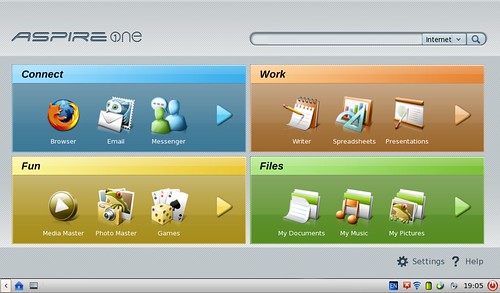
As an experiment, I wiped the hard disk of one aspire and replaced it with Acer’s custom Linpus – which boots up in about 15 seconds and points you straight to the basics of Firefox, Open Office, etc. on the one screen. Most kids and teachers I know who have never used Linux are able to do the most common things with this distro fairly easily. The same could be said of eee’s Xandros. The opening screens in both distros are extremely simple to follow – and when your main focus is the web, there’s little more you need to worry about other than clicking on the ‘web’ icon:

I think bringing Linux into the mix is – part and parcle with netbooks generally – about focusing on the ‘less is more’ principle. Seeing that all the applications are mostly web-based brings the focus on collaboration.

At the same time, focusing less on say making a song or editing swathes of video makes you appreciate simple things like online forums, RSS feeds, wikipedia pages and so on. There’s so much to be gained from the simple things on the web, and the more we look at the simple things, the more we realise how sophisticated those things can be.

Finally, I’d like to suggest that bringing Linux into a school and/or individual classroom is to some extent a political choice, regardless of our views. I think there’s a lot to be gained simply teaching others about the world of open source especially given that the vast majority of computer users don’t really know what the term is and have been reared on Microsoft or Apple products from day one. The fact that open source represents a viable and powerful alternative to proprietry solutions is amazing in itself – not to mention the fact that Linux is the technology backbone of the developing world.

For more thoughts on Linux in education, check out Clarence Fisher’s post in Remote Access.

Bringing Netbooks into the Classroom – Part one (of several)

You know that any given technology has hit the mainstream when your grandmother starts telling you all about it. And so it well may be that most of us bare witness to the humble, netbook which has taken the technology world by storm since its debut in late 2007. Technology analysts forecast sales of up to 30 million of these pint-sized techno-beauties over the next twelve months, with exponential growth to follow.

So, witnessing this micro-miracle unfolding, it was with a somewhat smug sense of prophetic confidence that I told my boss early last year that netbooks would in due course surely mean big business for educators. Although it wasn’t hard to hedge bets in this area, I nonetheless acknowledge that the tea-leaves have been kind to me. It seems that governments, systems and schools are touting ultra-mobile, low-cost, low-power devices as the surest path to one-to-one computing in Australian schools.

So where does that leave us in the classroom? All too often, we see technologies being pushed by big agendas onto unwitting teachers and students – and of course, we know that often those agendas are more about profitability and everything supporting it (showiness, sponsorship, friendly deals, etc.) than about supporting learning and teaching. Perhaps for this reason, many skeptics argue that netbooks aren’t the best solution for technology-poor, cash-strapped schools.

I would argue that netbooks do have a lot to offer to those in education circles, particularly in schools that have an existing base of suitably powerful machines that can do specialist things like sound recording, movie making and photo-editing – when the need arises. Netbooks cost next to nothing, which makes the prospect of parents buying them more likely. Their puniness in size makes hauling the requisite class-set (for many of us, up to 32 or more in number) less onerous. They can do most of the things we do most of the time on bigger computers. However, because of their less-powerful nature, they actually make us appreciate all of the less wizz-bang things that computing technology has to offer (for example, instead of making a movie or recording a song, I’ll sit down and actually work out how to use Open Office).

For teachers and students, I believe the real beauty of netbooks lies in their being used to supplement rather than substitute good teaching. Let’s face it, if most of us had netbooks available to us every lesson, we’d probably think less about planning the occasional ‘technology’ lesson and more about getting on with the business of good old-fashioned teaching. If we get the teaching side of things right, netbooks could be a fantastic resource, sitting snugly on the corner of a student’s desk, to be used where and when appropriate. Most importantly, this kind of technology needn’t be all-consuming (like playing a video of The Wiggles to a two year old). Don’t get me wrong – I’m all for being immersed in the world of technology – when real learning is happening. Problem is: plenty of teachers are happy to book computer labs with lessons that involve little more than searching in Google, cutting from Wikipedia and pasting in Word.

Perhaps the tiny size of the netbook serves as a reminder that good teaching should take centre stage before technology makes an appearance in our classrooms? In any case, I’m a supporter of netbooks both in my classroom and in classrooms around the developing and developed world. It’s going to be an interesting time as we watch politics, the economy and governments’ agendas being played out.

Lucky for me, while all of this is happening, I have a principal that listens to my advice. We’ve recently bought a few Acer Aspire One netbooks to try out with the kids and if things go well, we’ll go ahead and buy our first netbook trolley. This should be a really interesting time as technology makes its way into more and more classrooms.

Getting Started Collaborative Writing with Google Docs – Year 7 Connected Learning

Google Docs
Google Docs

Being an occasional blogger, I struggle with the pitfalls and perils of not maintaining an online presence as frequently as many of my blogging colleagues. Perfectionism is always a dangerous thing for bloggers, is it not?

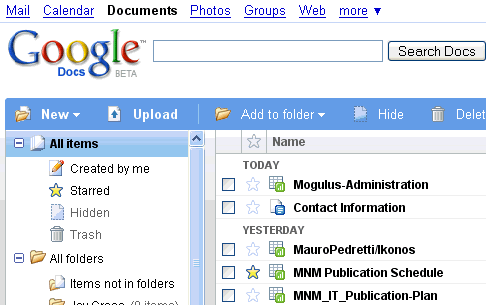
But when I hurled myself headlong into our new Connected Learning (an integrated curriculum) program and introducing Google Docs to over 180 Year 7 students last month, I thought I had found a worthy topic to resume my online pedagogical ramblings. For anyone who is unaware, an integrated curriculum usually combines several subjects into one large subject, which is often team-taught in larger classroom settings and may focus on themes which connect skills and content from the different disciplines being combined. Our integrated curriculum combines the subject areas of English, History, Geography and Religious Education.

We are currently in the throes of a unit entitled ‘My World’ which is mostly skills-based. What a good time, I thought, to introduce Google Docs?

Word to the wise: never assume that junior high school kids are capable of: (1) starting a Google account and verifying their email address; (2) spelling their email addresses; or (3) remembering their passwords. Had I the time over, Google Apps – which allows a teacher or education administrator to set up a school domain name and bulk email addresses – is a  good option for getting kids online, especially when trying to work with 180 of them at once in a large learning space. But at least our kids learned that when you don’t spell correctly, verify an email account inquiry or remember your password (or any combination of these), you can’t expect to get on and start an assignment. Such learning curbs – priceless though they may be – also leave many a teacher with a hankering for ‘a valium sandwich,’ to quote one of my Connected Learning Colleagues.

Nevertheless, after about 4 50-minute lessons, much moaning, groaning and gnashing of teeth, we had our entire Connected Learning cohort online, Google Doc’ing and collaborating in a real time frenzy of creativity.

If you haven’t had the chance to trial collaborative writing with your students, I thoroughly recommend it. If you have, I’d love to hear about some of the activities you’ve tried.

Slam that poem!

poetry_slam0

As the year comes to a close, many teachers tend to become a little sentimental and melancholic about  letting go of classes we’ve enjoyed so much. Without a doubt, the pride of my teaching joy this year has been my year 8 English class. Consisting of students who have been identified as major trouble-makers in other subjects, I’ve been delighted to have no significant issues with behaviour or attitude to school work. It seems that using technology in a (hopefully) dynamic and innovative way, incorporating substantial choice and responding to students’ initiatives with flexibility and leighway have all worked in my favour. Now I just have to get ready to say goodbye to the kids! 🙁

Here’s a video on a unit that we all had a lot of fun with. The topic was entitled ‘Poetry Slam’ and explored how performance poets and hip-hop artists communicate their frustration about problematic issues in society through verse, rhythm, rhyme and music. A few other year 8 teachers also picked up this topic and the result was that the kids had quite a positive PBL-like experience that didn’t necessarily count towards their grade but that had them quite engaged, as you’ll see.

These podcasts and the reflection come courtesy of GarageBand and iMovie, both of which the kids found very easy to use:

[youtube=http://au.youtube.com/watch?v=Yjcz1L8BNxQ]

Wikipedia and Meta-textuality


For too long I’ve bemoaned the presence of an overwhelming number of teachers, administrators and academics who grumble about students going to Wikipedia for information on a topic. Typical complaints include “you can’t be sure whether the facts are true or not,” “the authors lack credibility” and so on…

What these educators who are afraid of Wikipedia seem to miss is the fundamental point that Wikipedia has almost single-handedly redefined authenticity by virtue of creating a platform for collaborative writing that traverses boundaries; be they cultural, linguistic, political, or geographical. Time and time again, we realise that when two, ten, several hundred or a thousand authors get together to combine their expertise on any given topic, the result is far from unautentic, spurious or even poorly written. If anything, it’s possible to argue that a multiply-authored work in progress informed by univsersal freedom of speech is about as credible or authentic as you can get.

Needless to say, I’m a big fan of Wikipedia and promote it in all my classes. Having said that, there is a possibility that when kids superficially skim any factual information page, they’re missing the point: to blindly accept something after one reading without question (which we unfortunately reinforce at times) is equally dangerous.

So how do we really begin with Wikipedia in our teaching? I think that meta-textuality is a crucial concept for kids to understand if they are going to critically engage with Wikipedia pages in the way that we would like.  The fact is, with any page that we find on Wikipedia.org – the “discussion” tab is often more insightful than the main article. Just read the discussion page on Madonna, for instance, and you get a strong sense of how that page was constructed – the numerous points of disagreement, the delineation of sub-topics, the inappropriate wording and so on. Such a focus is a unit of work in itself!

Taking all of this on board, I wrote a Wikipedia analysis scaffold to get students thinking about how best to make critical use of Wikipedia pages. Feel free to download the DOC file and adapt to your needs. I’d also love to hear about what you do with Wikipedia in the classroom!

Wikipedia Analysis Scaffold