
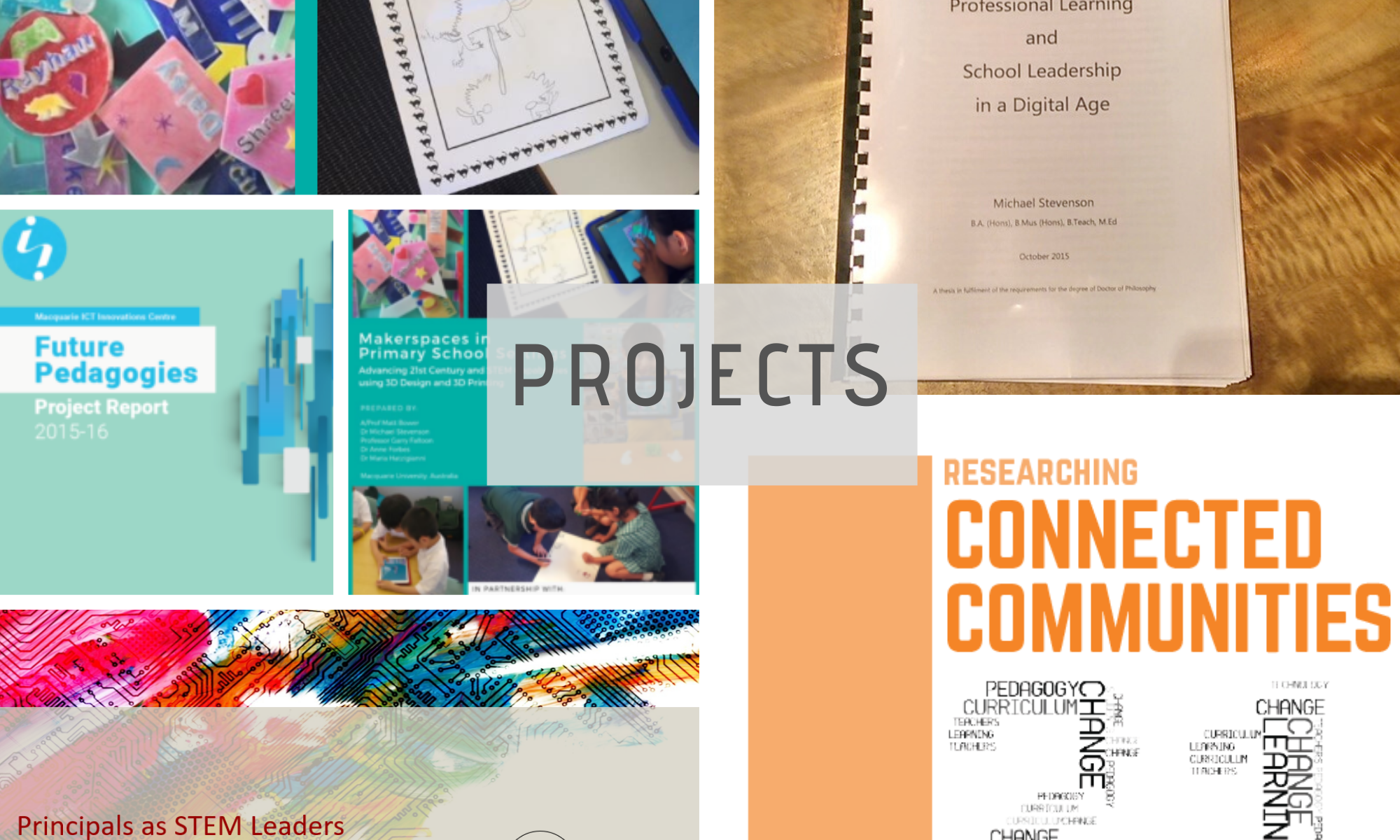
Through teaching, course development, professional learning, and research, my projects explore the intersection between technology and education. Collaborating with educators and academics from around Australia, my work has had state-wide and national impact.
Investigating the pedagogies and participatory cultures of screen sharing in contemporary digital classrooms

Contemporary digital classrooms are embracing digital learning in plethora of forms such as cross-platform devices through BYOD, sophisticated digital learning designs, social learning management systems, ubiquitous internet access, and technology-mediated tasks in areas such as coding, robotics, and multimedia. In such classrooms, learners and teachers need to understand the complexities of navigating and inhabiting shared physical and digital learning spaces. Traditional “stand-and-deliver” models such as the one teacher in front of the class utilising a single computer with a data projector are grossly inadequate for addressing the needs of today’s learners (Zhao, 2018). By investigating how screen sharing technologies may influence student and teacher participation, the proposed study accords with current research and policy stressing the importance of both pedagogical fluency and digital literacy.
Principals as STEM Leaders (2018-2020)

Principals as STEM Leaders is a national project funded by the Australian Government Department of Education and Training, under the Inspiring all Australians in Digital Literacy and STEM – Embracing the Digital Age measure of the National Innovation and Science Agenda (NISA). The project explores the need for a science, technology, engineering and mathematics (STEM) skilled workforce to ensure Australia remains globally competitive. I’m currently coordinating the research and professional learning activities in New South Wales.
Makerspaces in Primary School Settings (2017-2018)
Final report:
Bower, M., Stevenson, M., Falloon, G., Forbes, A., Hatzigianni, M. (2018). Makerspaces in Primary School Settings – Advancing 21st Century and STEM capabilities using 3D Design and 3D Printing. Sydney, Australia: Macquarie University. Available at: https://primarymakers.com.

The Makerspaces in Primary School Settings project examined how maker activities using 3D design and 3D printing technology could enhance learning and teaching outcomes. In my 12-month postdoctoral research role for this project, I coordinated extensive research activities across three schools, including several rounds of interviews, questionnaires, video screen recordings, and classroom observations. I was the principal data analyst and substantive writer of the report documentation.
Future Pedagogies Project (2015-2016)
Final report:
O’Sullivan, K-A., Stevenson, M., Howe, C., & Angel, K. (2016). Future pedagogies. Sydney: Macquarie ICT Innovations Centre. Available at: here.

Future Pedagogies explored how educators develop, employ and evaluate pedagogies to meet the evolving needs of their school communities. Its purpose was to immerse teachers in research that was relevant to their contexts and which could inform their pedagogical development. As a teaching focus lecturer working in conjunction with the Macquarie ICT Innovations Centre, I designed the study, organised funding, managed the research activities, mentored junior research assistants, and substantively drafted the final report.
Professional Learning and School Leadership in a Digital Age (PhD Thesis, 2013-2016)
Thesis:
Stevenson, M. (2015). Professional Learning and School Leadership in a Digital Age (Doctoral dissertation, Macquarie University, Sydney Australia). Available here.

My PhD study explored the changing nature of professional learning in a digital age. With recourse to models such as the Personal Learning Network (PLN), Participatory Cultures and the Technological, Pedagogical and Content Knowledge (TPaCK), the study employed a mixed research design that examined the dimensions of contemporary technology-enabled teacher professional learning and investigated its impact on school communities. Findings were drawn from three distinct samples of educators that include preservice teachers, classroom teachers, technology mentors and principals.
Connected Communities 21 (2013-2014)
Final report:
Stevenson, M., Howe, C., & Hedberg, J. G. (2014). Researching connected communities 21. Sydney: Macquarie ICT Innovations Centre. Available here.

This project was developed as a research and professional learning partnership between Macquarie ICT Innovations Centre (MacICT) and the Department of Education and Communities (DEC) in December 2012, with both professional learning and research activity undertaken throughout 2013. The research component of the project explored how schools self-manage change when confronted with the pressures of a redeveloping materials for changing curriculum, adopting new technologies and re-thinking pedagogies. I coordinated the research activities and was the lead researcher and lead author of the final report.
Transforming the Educational Digital Supply Chain Project

The Transforming the Education Digital Supply Chain (TtEDSC) project was a partnership project exploring the NBN – Enabled Education & Skill Services (NBNEESS) funded program. The study focused on exploring the efficient way of using the NBN for the current and next generation of students in all schools, as well as focusing on those who are keen to participate but do not have access to the tools available.
Evaluation of ABC Splash Portal
Final report:
Hedberg, J., Stevenson, M., & Highfield, K. (2014). Evaluating the effectiveness of the ESA – ABC Splash website through user research and feedback. Sydney: Macquarie University.

The ABC Splash learning portal represents a collaborative project between Education Services Australia (ESA) and the Australian Broadcasting Corporation (ABC). A research team from the School of Education at Macquarie University evaluated the development, rollout and use of the site by students, teachers and parents.
Primary Teachers’ Representational Practices in Science
Key paper:
Nichols, K., Stevenson, M., Hedberg, J., & Gillies, R. M. (2016). Primary teachers’ representational practices: from competency to fluency. Cambridge journal of education, 46(4), 509-531.

Primary Teachers’ Representational Practices in Science was a funded ARC study explores the impact of professional learning on primary teachers’ conceptual understanding and uptake of the use of visual representations in the science classroom. The study also highlights key representational competencies teachers require if they are to foster representational competence in students.